Tuesday, May 28, 2013

Joke. Joke. Bit of story. Joke. Joke. Joke on bit of story. Joke. Sto-Joke.

Thanksgiving with my family is always a a diverse, terrifying affair. 
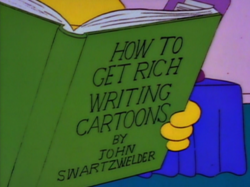
Since leaving the writing staff of The Simpsons, John Swartzwelder has spent the last decade writing nine short novels, eight of which center on the adventures of dimwit detective Frank Burly. In one of his latest books, Burly gets himself involved with boring-turned-mad scientists who conduct experiments based on what they see in old Hollywood movies. Burly bumbles his way through solving the case in standard Swarzweldian fashion, meaning it's packed with non sequitur and throwaway jokes that often reveal something ludicrous or break the fourth wall.

Like all of the Burly novels, it gets goofy. This isn't standard YA literature by any means, but students with broad pop culture knowledge will be able to recognize most of the material he uses for jokes in this one, and Swartzwelder's writing style has transferred well from television to prose, although I have been imagining scenes from this book in cartoon form, with lots of quick smash cuts and reveals when something sudden happens. Think of it as an episode of classic Simpsons, completely unfiltered for TV. Now you're getting it. Now give it back, it's mine.

What this book lacks in revelation/empowerment/strong emotional pull for YA readers, it makes up for it in complete insanity. I realize Swartzwelder isn't a YA author, nor does he write for a specific audience other than people who find humor in his demented cartoon universe. This is strictly for those with an advanced sense of comedy and crave something warped. This might serve as a stepping stone to thicker works of wackiness, such as those of Terry Pratchett.

READ THIS BOOK 

If you require absurd humor in your life, or know a YA reader who enjoys pop culture references and completely bizarre plots. So, you know, everyone. 

You may also read this book. Disclaimer: You probably will not get rich.


DON'T READ THIS BOOK 

If you want something serious, or need your literature to do more than give you some laughs. This reminds me of John Green's statement that he prefers to write about smart people, which might be a reaction to sitcom TV in which most characters are fairly dumb and the emotional currency rendered counterfeit. In the case of Swartzwelder, the characters are overly stupid, which does limit the depth of thought, but does open the opportunity for some incredible jokes. 


NEXT TIME, I YELL ABOUT

A book I read as a kid, and revisit 20+ years later to analyze how old that makes me. Let's just say this sign might stop traffic in the state of Oregon!


BORING STUFF

John Swartzwelder 
2011 Kennydale Books

Sunday, May 19, 2013

The Fault In Our YA Star


I've read 3 of these 5 books, so I'm qualified to whine about them all.

LOOKING FOR PAPER TOWNS

Doesn't matter who the author is - read more than two of their books and you'll see their patterns. This is not a criticism, but an observation. Here are a few I've noticed:

TC Boyle: uses words nobody else knows. Probably owns a thesaurus the size of a bread truck.
John Grisham: Always with the lawyer crap.
Vonnegut: Can't help but insert himself, or elements from his own life, into his stories
Tolkien: Nothing like reading about singing dwarves
Stephen King: Lots of boring things happen, then something scary happens. Repeat.
Gertrude Stein: Completely insane.

I repeat: THIS IS NOT A BAD THING. These patterns reveal much of the author, and despite +John Green's attempt to dissuade us from divining anything about the author from the fiction they write as dismissing the merit of the novel itself* (spoiler alert: wrong!) we can learn much about him as a writer, when comparing The Fault In Our Stars to Looking For Alaska and Paper Towns.


*When Green asks his readers not to attempt to look for hidden meaning in the story, guess what? They're going to look for hidden meaning in the story. "I made it up" is not enough to convince anyone that he's inserting something about himself for us to find. And to say this diminishes the impact of the story itself, and that fiction doesn't matter if we look beyond the page to the author? I don't completely buy it. There is such a thing as compartmentalization, a capability most likely possessed and practiced by the "smart people" about whom Green prefers to write.

AN ABUNDANCE OF FAULT

I was going to scream and holler about how these books are all the same, but Green has already addressed this on one of his many web presences. So, we'll examine his own words on the matter.

The Fault in Our Stars is very different (it’s narrated by a girl; she is not in high school; her concerns are somewhat different from the concerns of my previous protagonists; etc.)
When quibbling differences in gender narration and school status (a 16-year old part time community college student as opposed to a high school student - big whoop) are what separate your books and make them very different (a word, by the way, that good writers know to avoid), you've got trouble. I accept the concerns argument, as the male narrators of the previous two novels tend to only suffer from debilitating social communication problems, rather than a terminal illness. This speaks to his larger point of exploring the Romantic Other, which is a fascinating concept, and what puts him on a shelf above most other YA authors:

 A lot of people read [Paper Towns] as a rewriting or a revision or a revisiting or whatever of Looking for Alaska, which is totally fine (books belong to their readers), but to me it is the complete OPPOSITE of LfA (one is about the legitimacy of Great Lost Love, and one is about the absolute ridiculousness and illegitimacy of Great Lost Love), or at least that’s what I intended.
No quarrel here. The thematic adjustment between the two is plain to see, and I think that Green puts another spin on Great Lost Love in Fault, which is to consider one's legacy after they've passed on, and what lies on the other side. Will the Great Lost Love be requited in the afterlife? Will it continue to live forever in the hearts of those still alive? By the way, Hazel's meditation on these sentiments that we seem to casually toss out when someone dies was fantastic. One of Green's strengths is deconstructing the everyday (or, as reviewers like to say, quotidian) phraseology of our culture and adding the right amount of cuss words to make us think, "yeah, screw that!"

That said, If you have to spell it out for your audience, maybe they're not that smart.

 (I also like smart people who do not find irony a convincing way to hide from intellectual engagement, which is the  A#1 reason I like writing about teenagers.)
Damn.
Katherines seems to me wholly different from my other books except in some uninteresting superficial ways (like, it also contains a road trip, and it also contains a romance and nerds, but those are boring and trivial similarities...
Whoa there, buddy. You just named boring and superficial differences between Fault and your other books to argue that they're very different, while pointing to trivial similarities as unjustifiable criticism.

In the end, Green knows the pratfalls of explaining his books - the relationship between author and reader is ever tenuous and subject to too much filling-in by the reader, whose individual interpretations will trump any point the writer tries to make. Such is the nature of perception. And, to an extent, personal relationships.

The reason most men are still boys.


THE STARS ALIGN

As for The Fault In Our Stars as a book on its own, I say this is Green's best. He's at his best when writing through the rawest of emotion that his characters must experience/suffer; it's lyrical without being schmaltzy and pedantic, tight, lucid, cogent, and other 25-cent words that would make Hazel Grace like me. 

This one took a while to get going, but the sustained intensity of the last half of the book cannot be denied. With Paper Towns, we're thrown right into Margo's magical night and disappearance (see, they're very different). Here, we have to slog through significant exposition before the story really kicks in - naught but a minor complaint about the pacing. 

The themes of this book: love the one you're with, leaving a legacy, what happens after we die, are all folded well into the narrative. The inclusion of a book-within-a-book device makes the metaphor more obvious; Hazel wants to know what happens to her favorite characters after a book ends. Yes, the afterlife of a fictional character. Do they find love, what happens, does anything happen? Just as we're unsure of anything after passing from this mortal coil, Hazel needs some kind of reassurance about these characters to whom she's married her own personal hopes. 

Selfishness plays a hefty role in this book. Each character deals with their own short-sighted wants, and they manifest in shouting matches, avoidance, and lots of crying, as most selfishness does. 

About Van Houten: Clean-cut author with massive internet presence writes about boozy a-hole recluse writer who refuses to read fan mail. Green must have had fun with this character. I'm digging for fact within fiction, which is a no-no, but I bet he had to make Van Houten an American so that the Dutch fellowshop he received would come through. Not to dismiss the power of storytelling, or anything. 

For all that's wonderful and moving about this book, he reduces his characters to near-stereotypes. Augustus plays video games and reads novels based on video games. Hazel watches America's Next Top Model and likes to be catty about it. Trivial, surface similarities, sure, but come on, branch out. I say this knowing that most readers enjoy the comfort of predictability, which is why there are so many book and movie series that recycle characters and plot lines and make millions of dollars. 

But here’s the thing: I am not the only writer. There are many, many writers creating a huge variety of stories—tens of thousands of novels will come out in 2012, for example—and it’s not really my responsibility to tell every possible story. I can only tell the truest versions of the stories I know, so that’s what I’m trying to do.
Amen, brother.

JOHN GREEN, JOHN GREEN


The John Green Book Checklist

  1. Young protagonist with ample vocabulary - word placement screams thesaurus
  2. Enigmatic love interest 
  3. Statement about the attractive nature of curvy girls
  4. Protagonist reads and continually refers to "classic" works of literature that no one reads anymore, but the characters create meaning from them to apply to their own experience
  5. Death (or presumption of death) is the main catalyst for action
  6. Jovial and loving parents who remain flat characters (exception: Fault explores the parental relationships more in-depth)
  7. A character who goes by their full name
  8. Protagonist thinks s/he is nothing special, but finds through his/her adventure to be capable of the extraordinary 
Follow these simple steps and you too can have a New York Times Bestseller! I think there's an element of teenage fantasy fulfillment in his writing, which is fine; that is where most, if not all, writing begins. However, he doesn't want me to talk about it, and if I do, a bunch of nerdfighters might beat me up with words, so I won't. Suffice to say: all three books satisfy, are uplifting in the face of losing someone forever, and Green acquits himself well as to character motivations in his own commentary, but I'll continue to divine fact from fiction just to get his goat. Because, you know, word of this will get to him. /Sarcasm.

NEXT TIME, I YELL ABOUT

Another John who has a formula and sticks to it. These probably aren't meant for young readers, but they're funny as hell and they read fast & easy. Let's just say what the cover of every one of his books says...BY THE WRITER OF 59 EPISODES OF THE SIMPSONS!


BORING STUFF

The Fault in Our Stars
John Green
2012 Dutton Juvenile

Sunday, May 12, 2013

Donnie Dark Dude

 I HONESTLY THOUGHT THIS WAS GOING TO BE A STARGATE FAN FICTION

You might think that a book with a cover like this: 


would not inspire such a thought. Clearly, my line of reasoning is nonsense, but when the author so closely resembles the departed Don S. Davis, I get my hopes up. 
Don S Davis
Oscar Hijuelos, I am disappoint. 
So it wasn't to be. HOWEVER, I am bound by the code of this blog, which dropped off my radar for a couple of weeks thanks to the pesky intercession of EARNING A LIVING, to comment upon Dark Dude, the latest of my YA conquests.

SHOW DON'T TELL

For a book written in the first person, Hijuelos does lots of showing. For example, I didn't figure out that this book was set in the 1970s until after page 100. He showed me, but I wasn't looking. Shame on me. 

Rico, our hero, is a Cuban boy living in a rough Hispanic neighborhood in NYC, but there's one problem: he looks like a gringo. White skin, dirty blond hair. So right away, we're shown  that Rico doesn't fit in anywhere. Add fuel: he spent much of his childhood hospitalized and didn't grow up with a core group of friends. I feel I've been shown too much. Take it away, Rico, it's HIDEOUS.

So Rico takes us through his pasy, his family, his hobbies, his daily life, and it's no mystery why he hitchhikes to rural Wisconsin to find a friend who won the lottery and moved there to start a farm. Because the first thought in anyone's mind when they win $75,000 is, "I want to live where it smells like cow poop." 

Anyway, through hard work, socialization, lots of beer drinking, and saving a friend from drug addiction, Rico learns a lot about life, love, and fitting in. Good for him. Kid needed it.

OKAY, NOW STOP

Perhaps I'm growing jaded by YA, but the plot structure was just too rigidly predictable, as is much of the standard symbolism and the "wave a classic book into the story to get kids to read it" trend, of which John Green is the most notorious offender. This time, it's Huck Finn. Rico compares his own hitchhiking adventure with his junkie pal Jimmy to Huck and Jim's float down the Mississippi. Ugh, really. Jimmy and Jim. Write their names on an iron skillet and smash my face in with it, because I DIDN'T SEE THE PARALLELS. But wait, there's MORE. JIMMY is a SLAVE to DRUGS. It all makes sense now. Then, THEN! Rico develops the idea for a comic book about a guy who can change his skin tone to be Caucasian or Hispanic at will. While the symbolism is so laughably overt, it does demonstrate the depths of Rico's loneliness and feelings as an outsider.

So, not a read to avoid, but it is long. I will soon read We Were Here, which is of a similar bent, and I'll probably be better prepared to discuss identity among Latino boys in the United States. 

 NEXT TIME, I YELL ABOUT

The works of John Green. I'm struggling with my own assessment of his writing. He's worshiped as the voice of the 21st Century YA but there's something askew, and I just can't find it. Let's just say I might find fault...IN OUR STARS!

BORING STUFF

Oscar Hijuelos
2009 Atheneum

Saturday, April 20, 2013

Some Girls Are? ARE WHAT?! AAAARRRRGGGGGGHHHHH

GIRLS: I STILL DON'T GET IT


Does the caste system of high school actually exist? I suppose we wouldn't have movies such as Mean Girls, Clueless, 10 Things I Hate About You, Dazed & Confused, The Breakfast Club, Pretty In Pink, 16 Candles, and anything else John Hughes ever wrote, without its existence, or some semblance thereof. I was too busy goofing around with the only 3-4 friends I had and avoiding extracurricular activities, to no avail. I did speech & debate for a while, marching band for a year, soccer all four, but I never fell in with groups or felt that there was a hierarchy to be understood and followed. I don't recall any athletes receiving preferential treatment, although they did stick to themselves and seemed to have some kind of fantasy that they were all-powerful. There wasn't a queen bitch group that inspired hushed whispers when they walked in slow-mo down the hallway in short skirts while some salacious, wailing guitar solo played in the background.

My experience won't discount the existence of such a phenomenon. So it was with great interest that I picked up Some Girls Are by Courtney Summers, to plumb the depths of female (and the better-known male) social depravity. To some people, high school is life, and it's evidenced by what they do after high school, which is usually nothing. Peaked too early, champs! Imagine my pleasure at the cat fights and psychological warfare! Imagine my disappointment in the lousy presentation and story elements that detract from the themes and message to the YA crowd.
On Amazon, Some Girls Are $4.
This book is brutal. To wit, this title offers:
  • Attempted rape
  • Physical assault
  • Drug & alcohol abuse
  • Intense psychological torment
    • using one's insecurities against them
    • using an attempted rape and physical abuse as leverage
    • Lots of locker vandalism* 
  • 150+ instances of the F word
  • Teenage girls lashing out at others for no particular reason
  • The horrifying proposition of getting through HS with no friends/allies
  • Internet-based defamation and character assassination  


*ONLY in high school is the locker a metaphor for the person, which is why it's okay to trash it to send a message to the individual. This doesn't happen at the gym, nor the bus station, but in high school, if you want to get to someone, you throw pig guts in their locker, or spray paint it, or whatever. AND IT WORKS EVERY TIME. 

WE BEGIN WITH THE REIGN OF TERROR

Regina, the #1 sycophant to Queen B Anna, is shunned and targeted for revenge by her former "friends" after being accused of having sex with Anna's boyfriend. Regina finds her only recourse to seek the company of Michael, one of her many victims of vicious rumor-spreading over the years. Why? BECAUSE THERE IS A TWIST! Michael's mom (dead now!) was Regina's counselor! Then there's 200 pages of horrible deeds and psychological torment between Regina and a host of enemies while she tries to work out her complex feelings for Michael, who will probably never forgive her. Nevermind Regina's body issues and how she uses others' insecurities against them. I see where Summers was going with this - the morally ambiguous Regina, who is actually a dynamic, if unsympathetic protagonist, tries to navigate her sudden change in social status while coping with crippling isolation, and sees her morals challenged at every step, whether trying to find out how former victims Michael and Liz really feel about her, and as she plots revenge against Kara, Anna, Jeannette, Bruce, Josh, and about 74 other people. That's fine and dandy, but she's no Walter White.

Summers does demonstrate the inherent differences in how boys and girls handle conflict without resorting to egregious stereotypes. I say egregious because some of this is stock; the boys get physical and then it's over for the time being. The girls are out to destroy each other's spirits through whatever means necessary, and it's never over. From my teaching experience, this is fairly accurate. There are no definite lines here, as boys do some of the psychological stuff and girls get into fist fights too, but as a generality it's acceptable. 

As a YA novel, it does raise issues that resonate with the YA crowd, and gives voice to the peer abuse that goes unseen by most, but it just seems so exaggerated that I can't buy it lock, stock, and two smoking barrels. I know this crap goes on because I'm dealing with a group of 7th/8th girls at my school these days who are circling and sniping, and much like this book, IT GETS OLD FAST.


AND NOW FOR A LIST OF ANNOTATED COMPLAINTS


Gratuitous use of expletives: I'm all for salty language, but the over-the-top use F and S and BS and golly gosh darn gets old after the first third of the book. Yes, teens curse. The words are powerful. They know that, I do, and so do you. It's a bid for authenticity that fails, or simply lazy writing. Some girls aren't into cursing like sailors, but then...some girls are.

Mixed messages. The narrator's life is a jumbled mess after her fall from the social elite, as it were, and perhaps the author's intent to convey this is through the numerous stare-downs, showdowns, and snippy interactions between Regina and the likes of Liz, Kara, Anna, Josh, Jeannette, and Bruce, but holy crap does this get confusing. There's so much going on between Regina and these people that I can't keep them all straight, and the quality of the story suffers, as they can't all be completely fleshed out. Some of these characters stay static; petty revenge is their only character trait. Liz stands out a bit for her perspective and relationship to Regina, and is explored in a painful way. Points for that. HOWEVER, even the interactions with Michael become tedious, with so many statements cut off by the other's anger or annoyance. They have a host of issues to work through, being that Regina destroyed his reputation at the school and turned him into a loner, a role he actually relishes while grieving the death of his mother, and for some reason he's the only person she feels comfortable around despite what she's done to him. If she's so afraid of being alone, WHY DOES SHE ALWAYS WANT TO SKIP SCHOOL TO BE ALONE. And what does she do on weekends? Her life is detailed Monday through Friday, as if the social strata of school is her life. For a lot of kids, it may be, but the ones I know? School doesn't represent that part of life. A lot of the plot seems stock,  and the character archetypes aren't at all bent, but we're supposed to sympathize with this person and her situation. Some YA girls aren't into generic plots and characters, although they are comforting and predictable, so some girls are.

The writing isn't all that great, either. So many simple sentences. They just go like this. And this. I'll kill for variety. Regina offers these one-sentence "philosophical insights" that become their own paragraphs, and they ring so hollow I can't help but laugh. It's that kind of cynicism that YA go through (I did it myself), and just like me, they mistake this kind of thinking for deep pathos, when it's really a helpless complaint.

Summers uses repetition as a crutch rather than an enhancement. I'm pretty sure I saw the phrase "afraid of being alone" four times on one page. Some of the time I think it's supposed to be funny, but the repetition of repetitions is more annoying than effective. THAT IS A LOT OF FEAR. And each of the confrontations plays out the same. She's catatonic with rage so often that steam should be shooting out of her ears.
Some girls aren't as hairy as Wile E. Coyote. Some girls are. 


Oversimplified portrayal of adults. Every grown-up in this book is a clueless jerk. I understand that YA feel this way from time to time, but this borders on farcical overkill. Mom and Dad are drones. The math teacher is a pervert, and PE teacher is a drill sergeant with a hangover. The well-meaning secretary is worthy of only scorn. Regina can't connect with mom. Some girls are not ready for this kind of pigeon-holing. Some girls, like Courtney Summers, are. 

This book won't f$%#ing end. COME ON. I have yard work to do. Can she just kiss Michael and stop being a moron? One of the better features of YA books is that characters remain in flux and do not change overnight, but this process is excruciating. I suppose that's my own bias coming to the surface combined with not being familiar with the structure of this kind of book. It just seems to be a collection of the same scenes with minute variations on repeat, which tiny bits of progress made and lost, and I want to scream, DO SOMETHING! And there's even a point in story where Regina tells herself the same.

At least we agree.

FINAL VERDICT

Unless Courtney Summers is some kind of secret genius who will makes us see the light by subjecting us to the endless suffering of Regina (probability? < 1%) we have here a stab at numerous YA issues that blizzards into a lumpy mess by the end. Girls: help me.

NEXT TIME, I YELL ABOUT

the adventures of a male outsider attempting to bridge the culture gap and find an identity, without going nuclear like our friend Regina. Let's just say there are some dark days in store for this dark dude!

BORING STUFF

Courtney Summers
2010 St. Martin's Griffin 

Saturday, April 6, 2013

Do British people say "Elephant Boot"?

ONCE MORE UNTO THE BREACH


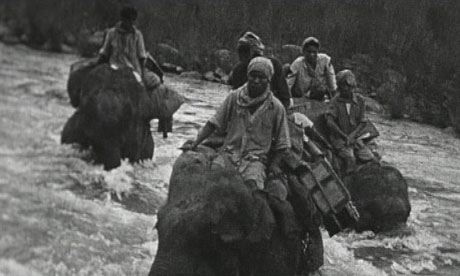
Roland Smith has a thing for elephants. It's not as disturbing and Paul Dowswell's aviation fetish, but a skim of Smith's bibliography shows many titles about animals, pachyderms in particular. Elephants are all right. I mean, they're humongous and have this incredible appendage that might be better than an opposable thumb, but I don't see the HOLY CRAP THIS ELEPHANT CAN TALK.

In my quest to accidentally read every YA book set in or around the Second World War, I was assisted by a student, to whom I recommended Wiesel's Night. He returned the favor by telling me about Elephant Run. 

"I read this book about a kid who was in the bombing of London during World War Two, and his mom sends him to Asia to be safe. And when he gets there, the Japanese invade. Pretty funny," he says. Yeah, I laughed my bleep off. But this is a kid who, if he doesn't like the book he's reading, chucks it into the street and watches cars destroy it. He also found Cormac McCarthy's The Road "hilarious". No surprise that he'd take sadistic pleasure in the misfortune of Nick Freestone, 14-year old boy and winner of the award for Worst Vacation Experience in YA Lit, 2009.

I regret not doing a visual review of my last blog entry, so this will be a poor replacement that sums up the plot of Elephant Run. Then, I finally get to complain.
Our young protagonist leaves this (and his mom)
for this (and his dad),
but falls right into this (with his dad),
and plans to escape like this (and of this I am jealous).

-The main elephant's name is Hannibal. Well-read dorks like me chuckle at this. Everyone else is clueless. I smirk in smug satisfaction and lose a dozen Facebook friends as a result.

-The budding relationship between Mya and Nick was somewhat ignored. All we know is that he notices her beauty and determination, but not much from her side. Too bad. I filled in by imagining that she hates his guts and pukes whenever he looks at her funny.

-There's so much authentic vocabulary in here that your head will spin. It both enhances the story and made me dream that I needed to buy a dictionary.

-Hilltop, the sage monk, plays a role akin to Gandalf, without the death/rebirth conceit. He's ancient, yet strong and stout of mind, has influence over leaders and wild animals, and is seemingly invincible despite presenting himself as a doddering old man. He moves the youngsters along by aiding their plans to fulfill their quest.

-Sonji, the sympathetic captor archetype, is a good character. I wanted more depth from him. The haiku motif stands out as a shining example of how to write YA.

-Nice dose of reality when Nick first arrives as a doughy city boy, and transforms into a lean young man who looks like a local. Even better: he's so engrossed in spying on the Japanese that he annoys his love interest. I lol'd.

-Somewhat predictable ending, but that's okay - much of YA is this way, and rightfully so, but Smith keeps the action moving and the tension high. HOWEVER, the action dips in some spots as some characters debate morals of the invading Japanese. Yeah, we get it, they're ruthless, but not Sonji. Cutting down on the ethical quandary could have kept this book moving. Doing the same to an episode of Star Trek: The Next Generation would reduce each episode to a five minute short in which Data says something socially inept, Picard adjusts his uniform and makes the right decision with no advisement, and roll credits!

-This guy knows a lot about elephants and shares in great detail. I remembered about zero of it. Sorry.

This book is worth a read if you're into historical fiction and learning about other cultures. There's adventure in exotic locales, espionage, elephants knocking stuff over, people riding elephants, daring escapes, samurai swords, and explosions, without any gushy romance getting in the way. NOW THIS IS A BOY BOOK.

Riding elephants is so badass they even did it on The Bachelor, America's best contribution to world culture.

Thanks, insane student! You shall be rewarded handsomely.

BONUS!

Because you didn't ask (why didn't you? I'm hurt), here are the finalists for the best-ever songs about elephants.


NEXT TIME, I YELL ABOUT

a book by a girl, about girls, probably for girls, that may just influence you to buy stock in GlaxoSmithKline. Let's just say that was as cryptic as the title of the book in question!

BORING STUFF

Roland Smith
2009 Hyperion

Wednesday, April 3, 2013

A few words for a book without

Nothing to yell about today, just praise for a fine composition.

Shaun Tan is a sneaky story-teller. Based on the cover, one might think that The Arrival is about some strange creature entering human existence and causing mayhem. Close! It's about humans entering human existence and being totally clueless, also known as the story of every immigrant.

Excuse me, which way to scare the crap out of you?
Without words, Tan creates a surreal, bizarre-yet-gorgeous world that is just as cryptic to the story's protagonist as it is to readers. Impossible architecture, massive flocks of unknown creatures, people rushing to balloon transports, unreadable glyphs everywhere...I want to visit this magical land. But first, I want to speak the language.

Anyone who reads (views?) this book will have insight into the difficulties of the immigrant experience, and the varying motivations for people to up and move (or flee) to a new part of the world. There is hope laced with uncertainty, longing mixed with adaptation, and an overall wonder at the marvels of Tan's creation within the intertwining stories of people who help one another get by.

Dude, I'm tripping balls. 


THERE IS SO MUCH TO DO WITH THIS BOOK IN SCHOOL

-Have struggling writers create narratives based on parts of this book.
-Practice writing from a specific perspective.
-Study how pictures can tell a story as well as words.
-Practice public speaking by verbally narrating portions of the story
-Students create a spoken language for the graphic representations in the new world.
-Pair with social studies curriculum on immigration to America, of any time period.
-Relate a time in their own lives when they felt a similar sense of confusion and isolation
-Learn how the illustrations were created and try their hand at it
-Create a fictional culture that'll throw a newbie for a loop and present to the class
-Set up the classroom with signs in another language (with some visuals) and see who can decipher the directions
**LITERARY TERMS ALERT**
-Use with language arts instruction on foreshadowing, symbolism, motifs

I could go on and on, but I won't for the safety of my readers, all three of you. Suffice to say, The Arrival is the most useful YA book I've read in 2013, and I'll use it a lot in the coming years. Poignant and Moving without resorting to shmaltz and smarm. Love it.


NEXT TIME, I YELL ABOUT 

a brief stop for another frigging book set in WWII, and then it's off the Clique Town, USA for an examination of high school caste systems. Let's just say I'm going to scratch this seven year bitch!

BORING STUFF

Shaun Tan
2007 Arthur A Levine Books

Artist Website (not boring)

Sunday, March 24, 2013

It's Eleven Eleven somewhere

I may as well rename this blog JB yells about YA books written on or about the two world wars. Something about me: I did my undergraduate history colloquium on the First World War, so I have some minor expertise. There's so much to this war in the run-up, combat (not military strategy, gross!) and aftermath that bears careful study, and it's one of my favorite topics to cover in world studies. Therefore, to find a YA book that covers this territory is both exciting and nauseating. If it really captures the essence of the time period and the socioeconomic outcomes, let the party begin. Should it fall short in any way, it's going in the bottom of the fireplace and coming out the top. So, I approached Paul Doswell's Eleven Eleven with trepidation. 
Three lives. No second chance. One ring to rule them all.

PLOT

It's November 11, 1918, so you know what that means - NO SCHOOL! Not so fast, kiddos. This is the day in which 11/11 became a holiday, SO LISTEN UP. Enough of that. It's the last day of the Great War. Three teenage boys, on the front somewhere in Belgium try, to survive the waning hours of combat before the armistice officially takes hold at 11 a.m.; a German infantry, a British scalliwag, and an American hotshot pilot converge and must help each other in order to escape alive. Now thaaat's INTRIGUE!

WRITING

Glance at Dowswell's bibliography and you'll see that he's churned out half a dozen YA war novels in the last decade after years of writing non-fiction. Good for you, Paul; facts are hard! The prose is clear, and Dowswell mixes sentence lengths, throws in plenty of military slang and German terms to lend some authenticity to the proceedings, and generally does well to describe the mucky, wracked setting of the tale. HOWEVER (oh boy, it's gonna get good!) I saw the term "dummkopf" and thought, "COPYKOPF." Anyone who regularly reads YA knows that Scott Westerfeld essentially took ownership of the term through his Leviathan series, another bunch of books set around WWI, but steampunked up in a dazzling style. Sorry Paul late to the party on that one. Worse: this guy obviously has a hard-on for aviation, to the point that it's detrimental to the story. He spends SO LONG describing Eddie, the suave American, joyriding in his tinderbox of a plane. Air combat during the First World War was new, unpredictable, and deserves to be noted, but after reading two solid pages describing banking maneuvers, slamming joysticks around (gross) and daring turns to evade enemies, I thought I'd mistakenly picked up the Red Baron's diary. Get me out of here. Get back to the story. DO SOMETHING. Oh, finally, he was shot down, and all because he was out looking for one more enemy plane to shoot up in order to officially be a flying ace. Why? TO IMPRESS A GIRL. Come. on. 

CHARACTERS 

Naturally, the American is the most detached and selfish of the lot, at first. I suppose that stands to reason, as the USA entered the war at late stages, and didn't have a cultural horse in the race. Nice touch when Eddie, first generation American of German descent, speaks Deutsche to Axel, the German soldier, who questions why these two German boys are fighting one another. But ONCE AGAIN, it is too reminiscent of another's work - in this case the almighty Vonnegut, who recounted a similar anecdote when he was taken prisoner during WWII. The British kid is William, I think. I'm not going to look it up. He was duped into volunteering for military duty by the father of a girl he courted. It's established that YA readers in general question the motives of adults, but to demonstrate such cynicism, yeeouch! Some pointed truth, brother. 

Overall, the characters function as vessels of fear and survival. they all long for something at home and clearly have no idea what they're doing in the middle of this war that long ago lost its meaning, congruent to their decision to drop nationalistic urges of violence in favor of surviving the waning hours of combat and shelling.

THE FINAL VERDICT 

It's not what I would imagine the standard WWI novel to be for YA readers, but it can do in a pinch. It's no All Quiet On The Western Front, (Copykopf alert! The ending of Eleven Eleven is A LOT LIKE All Quiet's), but it does belong in the clump of books to offer students to enrich their understanding of WWI, the horrors of warfare, delusions of nationalism, putting differences aside to work together, and the whims of fanatic heads of state. Or, they could try on these tunes:

This is what Eddie puts on his Walkman before every flight. 

Everything I know I learned from metal. And 20+ years of school/work experience. Mostly the latter.

Decent book. I'm not repulsed by it, but it won't be the first WWI fiction recommendation. 

Below are a couple non-fiction WWI books that have plenty of visuals and describe in detail the atrocious human condition and cost. I have used these in my WWI curriculum with great success:


Eye Deep in Hell by John Ellis

NEXT TIME, I YELL ABOUT

A wordless book, sporting the same title as a forgettable Charlie Sheen movie, which doesn't narrow it down for you guessers. Let's just say this Arrival is better than this Arrival. 

BORING STUFF

Paul Dowswell
2012 Bloomsbury