ONCE MORE UNTO THE BREACH
In my quest to accidentally read every YA book set in or around the Second World War, I was assisted by a student, to whom I recommended Wiesel's Night. He returned the favor by telling me about Elephant Run.
"I read this book about a kid who was in the bombing of London during World War Two, and his mom sends him to Asia to be safe. And when he gets there, the Japanese invade. Pretty funny," he says. Yeah, I laughed my bleep off. But this is a kid who, if he doesn't like the book he's reading, chucks it into the street and watches cars destroy it. He also found Cormac McCarthy's The Road "hilarious". No surprise that he'd take sadistic pleasure in the misfortune of Nick Freestone, 14-year old boy and winner of the award for Worst Vacation Experience in YA Lit, 2009.
I regret not doing a visual review of my last blog entry, so this will be a poor replacement that sums up the plot of Elephant Run. Then, I finally get to complain.
.jpg) |
| Our young protagonist leaves this (and his mom) |
 |
| for this (and his dad), |
 |
| but falls right into this (with his dad), |
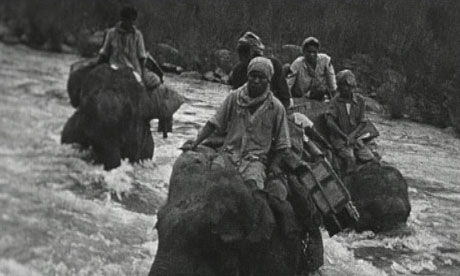 |
| and plans to escape like this (and of this I am jealous). |
-The main elephant's name is Hannibal. Well-read dorks like me chuckle at this. Everyone else is clueless. I smirk in smug satisfaction and lose a dozen Facebook friends as a result.
-The budding relationship between Mya and Nick was somewhat ignored. All we know is that he notices her beauty and determination, but not much from her side. Too bad. I filled in by imagining that she hates his guts and pukes whenever he looks at her funny.
-There's so much authentic vocabulary in here that your head will spin. It both enhances the story and made me dream that I needed to buy a dictionary.
-Hilltop, the sage monk, plays a role akin to Gandalf, without the death/rebirth conceit. He's ancient, yet strong and stout of mind, has influence over leaders and wild animals, and is seemingly invincible despite presenting himself as a doddering old man. He moves the youngsters along by aiding their plans to fulfill their quest.
-Sonji, the sympathetic captor archetype, is a good character. I wanted more depth from him. The haiku motif stands out as a shining example of how to write YA.
-Nice dose of reality when Nick first arrives as a doughy city boy, and transforms into a lean young man who looks like a local. Even better: he's so engrossed in spying on the Japanese that he annoys his love interest. I lol'd.
-Somewhat predictable ending, but that's okay - much of YA is this way, and rightfully so, but Smith keeps the action moving and the tension high. HOWEVER, the action dips in some spots as some characters debate morals of the invading Japanese. Yeah, we get it, they're ruthless, but not Sonji. Cutting down on the ethical quandary could have kept this book moving. Doing the same to an episode of Star Trek: The Next Generation would reduce each episode to a five minute short in which Data says something socially inept, Picard adjusts his uniform and makes the right decision with no advisement, and roll credits!
-This guy knows a lot about elephants and shares in great detail. I remembered about zero of it. Sorry.
This book is worth a read if you're into historical fiction and learning about other cultures. There's adventure in exotic locales, espionage, elephants knocking stuff over, people riding elephants, daring escapes, samurai swords, and explosions, without any gushy romance getting in the way. NOW THIS IS A BOY BOOK.
 |
| Riding elephants is so badass they even did it on The Bachelor, America's best contribution to world culture. |
Thanks, insane student! You shall be rewarded handsomely.
BONUS!
Because you didn't ask (why didn't you? I'm hurt), here are the finalists for the best-ever songs about elephants.NEXT TIME, I YELL ABOUT
a book by a girl, about girls, probably for girls, that may just influence you to buy stock in GlaxoSmithKline. Let's just say that was as cryptic as the title of the book in question!
BORING STUFF
Roland Smith
2009 Hyperion