Saturday, April 6, 2013

Do British people say "Elephant Boot"?

ONCE MORE UNTO THE BREACH


Roland Smith has a thing for elephants. It's not as disturbing and Paul Dowswell's aviation fetish, but a skim of Smith's bibliography shows many titles about animals, pachyderms in particular. Elephants are all right. I mean, they're humongous and have this incredible appendage that might be better than an opposable thumb, but I don't see the HOLY CRAP THIS ELEPHANT CAN TALK.

In my quest to accidentally read every YA book set in or around the Second World War, I was assisted by a student, to whom I recommended Wiesel's Night. He returned the favor by telling me about Elephant Run

"I read this book about a kid who was in the bombing of London during World War Two, and his mom sends him to Asia to be safe. And when he gets there, the Japanese invade. Pretty funny," he says. Yeah, I laughed my bleep off. But this is a kid who, if he doesn't like the book he's reading, chucks it into the street and watches cars destroy it. He also found Cormac McCarthy's The Road "hilarious". No surprise that he'd take sadistic pleasure in the misfortune of Nick Freestone, 14-year old boy and winner of the award for Worst Vacation Experience in YA Lit, 2009.

I regret not doing a visual review of my last blog entry, so this will be a poor replacement that sums up the plot of Elephant Run. Then, I finally get to complain.
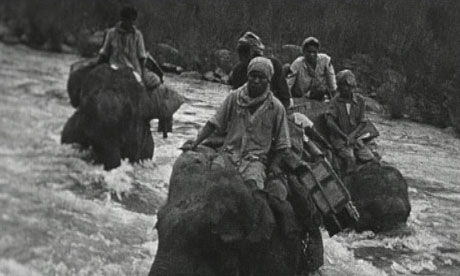
Our young protagonist leaves this (and his mom)
for this (and his dad),
but falls right into this (with his dad),
and plans to escape like this (and of this I am jealous).

-The main elephant's name is Hannibal. Well-read dorks like me chuckle at this. Everyone else is clueless. I smirk in smug satisfaction and lose a dozen Facebook friends as a result.

-The budding relationship between Mya and Nick was somewhat ignored. All we know is that he notices her beauty and determination, but not much from her side. Too bad. I filled in by imagining that she hates his guts and pukes whenever he looks at her funny.

-There's so much authentic vocabulary in here that your head will spin. It both enhances the story and made me dream that I needed to buy a dictionary.

-Hilltop, the sage monk, plays a role akin to Gandalf, without the death/rebirth conceit. He's ancient, yet strong and stout of mind, has influence over leaders and wild animals, and is seemingly invincible despite presenting himself as a doddering old man. He moves the youngsters along by aiding their plans to fulfill their quest.

-Sonji, the sympathetic captor archetype, is a good character. I wanted more depth from him. The haiku motif stands out as a shining example of how to write YA.

-Nice dose of reality when Nick first arrives as a doughy city boy, and transforms into a lean young man who looks like a local. Even better: he's so engrossed in spying on the Japanese that he annoys his love interest. I lol'd.

-Somewhat predictable ending, but that's okay - much of YA is this way, and rightfully so, but Smith keeps the action moving and the tension high. HOWEVER, the action dips in some spots as some characters debate morals of the invading Japanese. Yeah, we get it, they're ruthless, but not Sonji. Cutting down on the ethical quandary could have kept this book moving. Doing the same to an episode of Star Trek: The Next Generation would reduce each episode to a five minute short in which Data says something socially inept, Picard adjusts his uniform and makes the right decision with no advisement, and roll credits!

-This guy knows a lot about elephants and shares in great detail. I remembered about zero of it. Sorry.

This book is worth a read if you're into historical fiction and learning about other cultures. There's adventure in exotic locales, espionage, elephants knocking stuff over, people riding elephants, daring escapes, samurai swords, and explosions, without any gushy romance getting in the way. NOW THIS IS A BOY BOOK.

Riding elephants is so badass they even did it on The Bachelor, America's best contribution to world culture.

Thanks, insane student! You shall be rewarded handsomely.

BONUS!

Because you didn't ask (why didn't you? I'm hurt), here are the finalists for the best-ever songs about elephants.


NEXT TIME, I YELL ABOUT

a book by a girl, about girls, probably for girls, that may just influence you to buy stock in GlaxoSmithKline. Let's just say that was as cryptic as the title of the book in question!

BORING STUFF

Roland Smith
2009 Hyperion

Wednesday, April 3, 2013

A few words for a book without

Nothing to yell about today, just praise for a fine composition.

Shaun Tan is a sneaky story-teller. Based on the cover, one might think that The Arrival is about some strange creature entering human existence and causing mayhem. Close! It's about humans entering human existence and being totally clueless, also known as the story of every immigrant.

Excuse me, which way to scare the crap out of you?
Without words, Tan creates a surreal, bizarre-yet-gorgeous world that is just as cryptic to the story's protagonist as it is to readers. Impossible architecture, massive flocks of unknown creatures, people rushing to balloon transports, unreadable glyphs everywhere...I want to visit this magical land. But first, I want to speak the language.

Anyone who reads (views?) this book will have insight into the difficulties of the immigrant experience, and the varying motivations for people to up and move (or flee) to a new part of the world. There is hope laced with uncertainty, longing mixed with adaptation, and an overall wonder at the marvels of Tan's creation within the intertwining stories of people who help one another get by.

Dude, I'm tripping balls. 


THERE IS SO MUCH TO DO WITH THIS BOOK IN SCHOOL

-Have struggling writers create narratives based on parts of this book.
-Practice writing from a specific perspective.
-Study how pictures can tell a story as well as words.
-Practice public speaking by verbally narrating portions of the story
-Students create a spoken language for the graphic representations in the new world.
-Pair with social studies curriculum on immigration to America, of any time period.
-Relate a time in their own lives when they felt a similar sense of confusion and isolation
-Learn how the illustrations were created and try their hand at it
-Create a fictional culture that'll throw a newbie for a loop and present to the class
-Set up the classroom with signs in another language (with some visuals) and see who can decipher the directions
**LITERARY TERMS ALERT**
-Use with language arts instruction on foreshadowing, symbolism, motifs

I could go on and on, but I won't for the safety of my readers, all three of you. Suffice to say, The Arrival is the most useful YA book I've read in 2013, and I'll use it a lot in the coming years. Poignant and Moving without resorting to shmaltz and smarm. Love it.


NEXT TIME, I YELL ABOUT 

a brief stop for another frigging book set in WWII, and then it's off the Clique Town, USA for an examination of high school caste systems. Let's just say I'm going to scratch this seven year bitch!

BORING STUFF

Shaun Tan
2007 Arthur A Levine Books

Artist Website (not boring)

Sunday, March 24, 2013

It's Eleven Eleven somewhere

I may as well rename this blog JB yells about YA books written on or about the two world wars. Something about me: I did my undergraduate history colloquium on the First World War, so I have some minor expertise. There's so much to this war in the run-up, combat (not military strategy, gross!) and aftermath that bears careful study, and it's one of my favorite topics to cover in world studies. Therefore, to find a YA book that covers this territory is both exciting and nauseating. If it really captures the essence of the time period and the socioeconomic outcomes, let the party begin. Should it fall short in any way, it's going in the bottom of the fireplace and coming out the top. So, I approached Paul Doswell's Eleven Eleven with trepidation. 
Three lives. No second chance. One ring to rule them all.

PLOT

It's November 11, 1918, so you know what that means - NO SCHOOL! Not so fast, kiddos. This is the day in which 11/11 became a holiday, SO LISTEN UP. Enough of that. It's the last day of the Great War. Three teenage boys, on the front somewhere in Belgium try, to survive the waning hours of combat before the armistice officially takes hold at 11 a.m.; a German infantry, a British scalliwag, and an American hotshot pilot converge and must help each other in order to escape alive. Now thaaat's INTRIGUE!

WRITING

Glance at Dowswell's bibliography and you'll see that he's churned out half a dozen YA war novels in the last decade after years of writing non-fiction. Good for you, Paul; facts are hard! The prose is clear, and Dowswell mixes sentence lengths, throws in plenty of military slang and German terms to lend some authenticity to the proceedings, and generally does well to describe the mucky, wracked setting of the tale. HOWEVER (oh boy, it's gonna get good!) I saw the term "dummkopf" and thought, "COPYKOPF." Anyone who regularly reads YA knows that Scott Westerfeld essentially took ownership of the term through his Leviathan series, another bunch of books set around WWI, but steampunked up in a dazzling style. Sorry Paul late to the party on that one. Worse: this guy obviously has a hard-on for aviation, to the point that it's detrimental to the story. He spends SO LONG describing Eddie, the suave American, joyriding in his tinderbox of a plane. Air combat during the First World War was new, unpredictable, and deserves to be noted, but after reading two solid pages describing banking maneuvers, slamming joysticks around (gross) and daring turns to evade enemies, I thought I'd mistakenly picked up the Red Baron's diary. Get me out of here. Get back to the story. DO SOMETHING. Oh, finally, he was shot down, and all because he was out looking for one more enemy plane to shoot up in order to officially be a flying ace. Why? TO IMPRESS A GIRL. Come. on. 

CHARACTERS 

Naturally, the American is the most detached and selfish of the lot, at first. I suppose that stands to reason, as the USA entered the war at late stages, and didn't have a cultural horse in the race. Nice touch when Eddie, first generation American of German descent, speaks Deutsche to Axel, the German soldier, who questions why these two German boys are fighting one another. But ONCE AGAIN, it is too reminiscent of another's work - in this case the almighty Vonnegut, who recounted a similar anecdote when he was taken prisoner during WWII. The British kid is William, I think. I'm not going to look it up. He was duped into volunteering for military duty by the father of a girl he courted. It's established that YA readers in general question the motives of adults, but to demonstrate such cynicism, yeeouch! Some pointed truth, brother. 

Overall, the characters function as vessels of fear and survival. they all long for something at home and clearly have no idea what they're doing in the middle of this war that long ago lost its meaning, congruent to their decision to drop nationalistic urges of violence in favor of surviving the waning hours of combat and shelling.

THE FINAL VERDICT 

It's not what I would imagine the standard WWI novel to be for YA readers, but it can do in a pinch. It's no All Quiet On The Western Front, (Copykopf alert! The ending of Eleven Eleven is A LOT LIKE All Quiet's), but it does belong in the clump of books to offer students to enrich their understanding of WWI, the horrors of warfare, delusions of nationalism, putting differences aside to work together, and the whims of fanatic heads of state. Or, they could try on these tunes:

This is what Eddie puts on his Walkman before every flight. 

Everything I know I learned from metal. And 20+ years of school/work experience. Mostly the latter.

Decent book. I'm not repulsed by it, but it won't be the first WWI fiction recommendation. 

Below are a couple non-fiction WWI books that have plenty of visuals and describe in detail the atrocious human condition and cost. I have used these in my WWI curriculum with great success:


Eye Deep in Hell by John Ellis

NEXT TIME, I YELL ABOUT

A wordless book, sporting the same title as a forgettable Charlie Sheen movie, which doesn't narrow it down for you guessers. Let's just say this Arrival is better than this Arrival

BORING STUFF

Paul Dowswell
2012 Bloomsbury

Friday, March 15, 2013

BANNED!

Not Appearing In Chicago:


Whoops! We recommended a book with real-world experiences to kids!

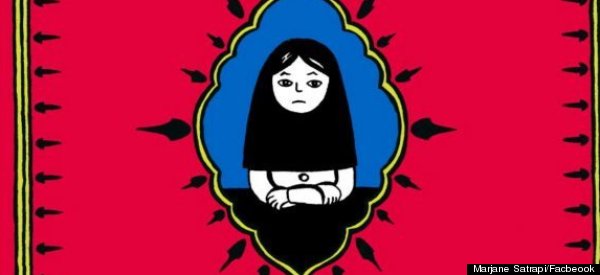
Well, sort of. Persepolis, which I've previously reviewed, has been ruled unfit for consumption by 7th graders in Chicago schools. Which is fine, because as we all know, when a book gets this kind of attention, lots of people will protest, bring attention to the matter, and many readers will find it on their own. It's encouraging to see parents and students protesting a decision they see as censorship, but the establishment has a point in keeping the book out of 7th grade classrooms. Persepolis does contain mature content that may be too much for 12- and 13-year old students to handle. But should that possibility be reason enough to prevent teachers from giving other students the option of pursuing this book in class? Would it hurt for a CPS student to wait a year to read this book in class? Will I stop asking questions that end with the words in class?

First of all, the book was recommended to 7th graders by Chicago Public Schools, as stated in the article. MAKE UP YOU MIND, CPS. This is now a case of hindsight, and is most damning in demonstrating that the school district does not know what it recommends (dictates?) the literature used in the classroom. Forget censorship - who oversees the material that is pumped into Chicago's schools?

I wore this to Guy Montag's house. Now I'm dead.

Author Marjane Satrapi, of course, is beside herself, and has plenty to say about free speech and democracy, and rightfully so - the irony of her book about individualism, rebellion, and oppressive cultural values being removed from a classroom in the Unites States speaks for itself. However, the school district has only removed the book from classrooms; it's still available in school libraries. Regardless, it's an act of denying a book to a certain age group by a public official. Is the CEO justified? Maybe. Overreacting? Possibly. This is more complex than standard censorship; irresponsibility and short-sighted planning are the real issues here.

Can I get on my soapbox and castigate the school district for assuming that a class of (probably 40) students would all want to, or be willing to read, any one book? Persepolis is an outstanding work of literature and art, but even this work won't capture everyone's imagination. Let's reform our classrooms! DOWN WITH UNIFORMITY! UP WITH CHOICE! DOWN WITH CONFORMITY! UP WITH...LETTING TEACHERS HELP STUDENTS FIND BOOKS TO READ TO MEET CURRICULUM GOALS!

Now, chant that for 6 hours.


Wednesday, March 13, 2013

The boy who harnessed the wind and made the rest of us feel like we're wasting our lives

I'm struggling with whether to put a fart joke here

Yeah well, I didn't invent a damn thing before I was 20, other than lies about my homework. 

I have nothing but praise. This guy has the goods. 

The Boy Who Harnessed The Wind is my-life-so-far book by a William Kamkwamba, who spent much of his adolescent years determined to bring free electricity and irrigation to his family's home in poverty- and drought-stricken Malawi. If you can point out Malawi on a map without labels, congratulations. It's a story of overcoming stiff odds and one person's drive to succeed and should rightfully be celebrated. At the same time, it strikes me as a cautionary tale for people in developed countries who take for granted the comforts of their lives, and to never stop thinking.

William pursued something that would improve his life, but also would teach him to put faith in science and human ingenuity over the "magic" purported to hold sway over the people in Malawi, and that he once believed to be a legitimate source of power. Further, he was ridiculed by others in his village for his pursuits, labeled a wacko pothead, which for a time brought shame to his family. There are heavy lessons in here for anyone willing to put in the time, e.g. my world studies class next term. SUCKERS! It's important, too, to read the final pages on being recognized for his achievements by the international scientific community, which goes to show that hard work and ingenuity will not go unrewarded. The guy got a free ride through college and on The Daily Show for crying out loud. 

I categorize this book as YA non-fiction for the following reasons:
1) It was a written by a young adult
2) Deals with concepts around self-improvement and self-discovery to which YA readers can relate
3) It reads smoothly, and the 960 Lexile means that is well within the range of high school readers. 
4) YOU CAN'T STOP ME.
5) We need more realistically uplifting non-fiction for our kiddos, and this one does the job, with the added benefit of supplementing the book with social studies content and all of the media around William and other inventors like him. I can see using this book in the classroom for years to come. 

Boring Stuff

William Kamkwamba (with Bryan Mealer)
2010 Reprint William Morrow


Next time, I yell about

a book about three teenage boys mired in a never-ending war, with one chance to get out alive. Let's just say  THE NUMBERS DO THE TALKING!


Tuesday, March 5, 2013

F-

There goes the damage deposit.


Dear Theodore Taylor,

I am writing to you today about your YA novel, The Bomb. You may be dead, but I have watched that X-Files episode in which a paranoid computer genius uploaded his consciousness to the internet about 19 times, and I dreamed that my great-grandmother has been trying to find security holes in latest version of Java so she can nag me. Also, I can't find my Ouija board. Let's assume this finds you.

"Oh look, another book about World War Two," I said to myself as I flipped through listings of YA books set in and around the Second World War. I am constantly looking for action-oriented stories for reluctant boy readers, and yours looked like the cover of a Megadeth album, bringing to mind the metal mania of Mustaine, Marty, Menza, and the other band members whose names don't start with M. Explosions! Destruction! Chaos! Sold.

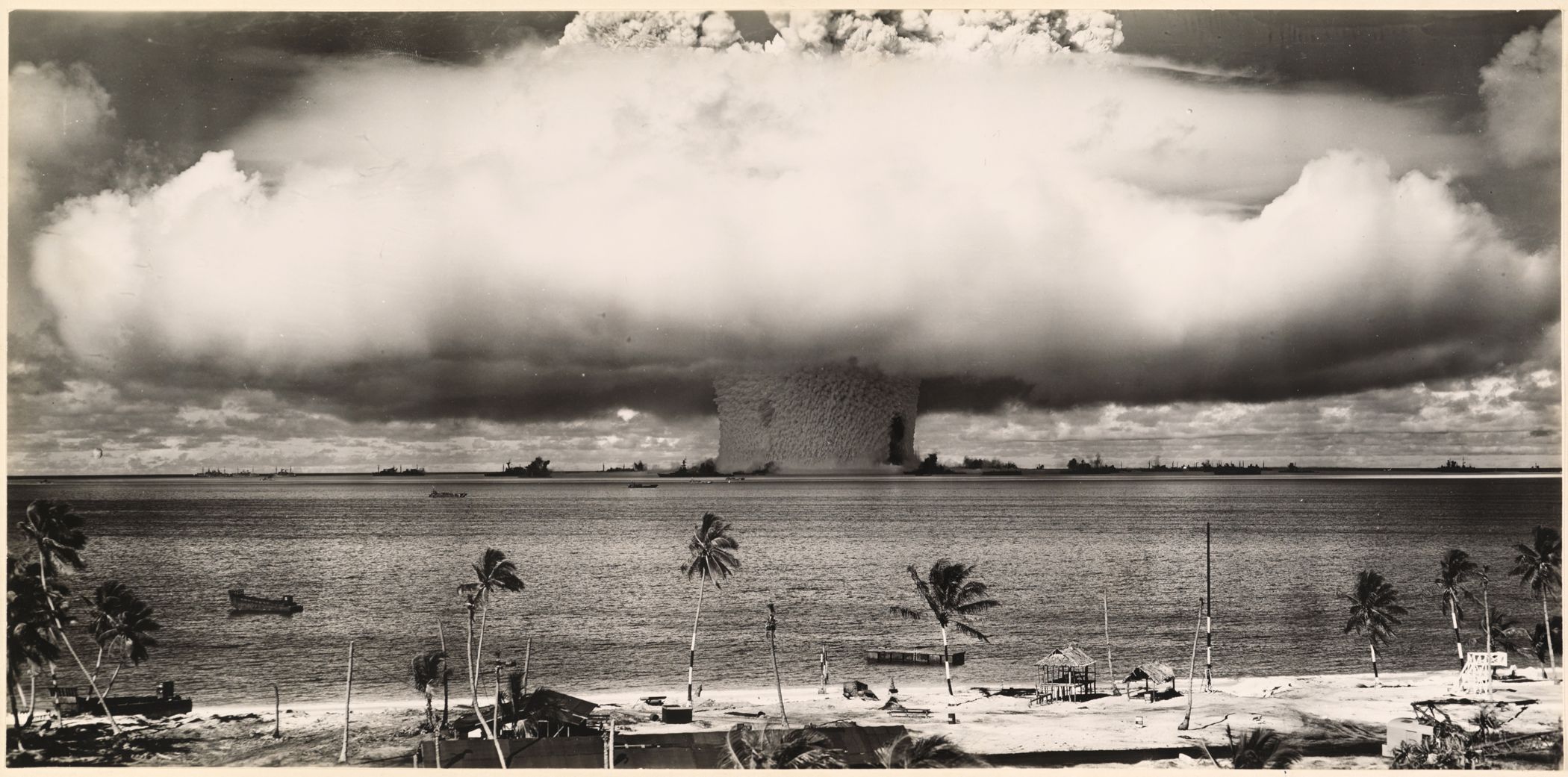
But wait, it's not an action novel. Damn you, Theodore Taylor! It's a tale of dubious morality and value-based conundrums as the imperialist modern era barges into formerly isolated outposts of humanity! There's even a list of discussion questions at the end of the book. YOU TRICKED ME, THEODORE TAYLOR. Instead of rip-roaring fight scenes, I spent 195 pages on painful inevitability reading about Sorry, the teenage Bikinian hellbent on rescuing his home from the most destructive man-made force: ego. Ha ha! I kid. I mean, of course, atomic weaponry. In a matter of days he's ripped from the cocoon of tropical island solitude and tossed aside for an arms race that both befuddles and angers him. As if that weren't fascinating enough, you include chapter interludes that chronicle the birth of the bomb and the process of bringing the bomb to Bikini. A brilliant stroke; as the two narratives come closer and closer to their final confrontation, I was jumping up and down screaming at Sorry to get the h-e-double-hockey-sticks out of there and fold in the face of powers much bigger than him.

The name Sorry: a linguistic coincidence? Cultural oddity? Cheap apology? Does Taylor see himself in Sorry's situation and feel...empathy for him? I don't get it. Last time it was a girl named Capable, now a boy named Sorry. If they had a kid, I guess the logical name choice would be Mediocre. Sure, the name Sorry is memorable and has some significance to the author, but I question the choice. Still, you could have done much worse, such as writing a book about super heroes called Heroes and naming one of the main characters Hiro. That would just be overt pandering, too self-evident, would completely alienate readers, who would laugh it off as hack work, and the venture would tank completely. Right? Answer: Not in television!

The characters are meh, with the exception of Uncle Abram. I get that Sorry is a confused teenager, but he's just not that interesting or sympathetic; for his people as a group, readers may develop feelings, but Sorry is bland, and his life-altering decision seems forced, as does the sentimental moment with his sister, who barely appears in the book, and her favorite doll. Auxiliary characters are there to simply move things along. That's no major detraction, as the plot drives this book all the way home and doesn't even ask for gas money. 

The last fifteen pages are unspeakably intense. The buildup was worth it. Any YA reader craving action will flip their lid at this climax. You can't possibly top this, can you, Theodore Taylor? No way. 

**SPOILER ALERT**

[Not for you, Theodore, you wrote the thing. This is for all two of my readers who may not want to read on for fear of substantial detail ruining the mystery of your book. It's a common term used on the Internet. That this has entered the lexicon vexes me]

Yes way. Mere moments after finishing the story, I picked up the book again to read the afterword, and you hit me in the chops: HE WAS AT THE BIKINI ISLANDS TO ARRANGE THE BOMB TEST. Theodore, I threw the book across the room. It's as close as I've ever come to a KHAAAAAAN! moment. Here was a nice little story about the infamous bomb test and its effect on people who never had a horse in the race, and you throw on top of it the authenticity and credibility of BEING THERE WHEN ALL OF THIS HAPPENED. All of my issues with characterization and narrative flow seem trivial in comparison to this story having churned inside of you for fifty years, waiting to be told.

Okay guys, the scary spoiler is gone!

Interesting Factoid From This Book That May Interest Only Me:
Sorry regards the albatross fly-by as an ominous sign of approaching danger, whereas in European maritime tradition, an albatross sighting is an omen of good luck. 

Thank you for this book with a misleading cover, somewhat flat characters, intense plot, clever structure, and bonus discussion questions so I don't have to think of any. A truly unforgettable work, which asks questions for which we still do not have answers.

Best,
JB

Boring Stuff

Theodore Taylor
2007 Graphia (reissue)


Next: I yell about a boy wonder in Africa. Let's just say it's going to be a BREEZE!


Sunday, March 3, 2013

George Saunders: Badass

False Start

I don't know how to begin
What is this I don't even
What else can be said for
WHY CAN'T I THINK OF A

*Clears Throat*


Okay, those are out the way, and I'm ready to write about George Saunders and his book, The Very Persistent Gappers of Frip. First and foremost, I'm legally obligated to notify readers that this story is not about legendary guitarist Robert Fripp, nor makes any reference to him, other than to praise his virtuosity and to exhort you (extort if you're nasty) to purchase the entire King Crimson catalog. 
Except for this.
I was introduced to George Saunders (the concept) by a college classmate, about fifteen minutes before seeing George Saunders (the man) give a live reading, mini-lecture, and Q&A about George Saunders (the author). He read some pieces that were eventually published in In Persuasion Nation, which takes great umbrage with consumer culture and so sadistically subverts it through unremarkable, largely unsympathetic protagonists*, trapped so deeply in the world of brand-naming and advertising that they're unable to think clearly for themselves. This is a recurring theme* throughout his works, which are difficult to categorize, if you're into that sort of thing. They're not quite futuristic fantasies, nor cautionary tales of dystopia* and social satire*. Yet, it's all of that. Some of the plots are absurd, yet not far-fetched.


Saunders's work has had a major impact on my reading interests and my writing. Anything off-kilter immediately captures my interest, but what he writes is so convincing, the dialogue in particular. He's so tuned into our spoken language that when it's on the printed page it looks foreign - yet this is how we talk. Many of his characters engage in up-talking*, that is, ending every sentence on a rising tone, as if asking a question. And I think, wow, this guy can't be stopped. Why can't I write like this? So I try, and turns out this is really hard, mom! Saunders has this down. Check it out:

"Being a man who knows something about grandfatherly disapproval, having  had a grandfather who  constantly taunted me for having enlarged calves - to the extent that even today, when bathing, I find myself thinking unkind thoughts about Grandfather - what I prayed on both occasions was: Dear Lord, he is what he is, let me love him no matter what. If he is a gay child, God bless him; if he is a non-gay child who simply very much enjoys wearing his grandmother's wig while singing Edelweiss to the dog, so be it, and in either case let me communicate my love and acceptance in everything I do." - from "My Flamboyant Grandson".

That's two sentences. TWO. But that's how we talk! If I received this in a language arts class I'd probably say to the kid, "Hey, that's some really complex sentencing you've created, but I think, because you're a young writer, that these long sentences with all the fancy punctuation marks like the semicolon* and dashes? Not to sound mean, but those should go, because you're not a famous author so you can't get away with that kind of thing yet, which is too bad, but that's how it goes, kid; so here's what you do: break them up into smaller chunks. Do you even know what a dependent clause* is?" - from my really bad impression of George Saunders just now.


*LANGUAGE ARTS TERMINOLOGY ALERT!


GET ON WITH IT!

What do you mean, you "forgot to pick up eye drops"?

So, the guy wrote a book for kids. As with the best kids books, this one works for YA and adult readers. While George tones down the complex sentences and keeps the story simple, there is enough strangeness and subtext for the older crowd. It's 84 pages, with gorgeous, fractured illustrations by Lane Smith, who most notably did the art for The True Story Of the Three Little Pigs.

The plot: In a seaside community of goat keepers, the gappers, spiny baseball-sized creatures with multiple eyes, are irresistibly drawn to goats. When they reach the goats, they issue high-pitched shrieks of joy that stress the goats, who won't produce milk. It's up to a little girl named Capable to find another way to make a living for her family when the goats won't give and the neighbors refuse to help.

The illustrations do well to augment the story, but it's all in the words. Sure, sure, the main idea is sharing and caring for one's fellow humans, but the themes can be applied to social studies discussions of forms of economy, how people interact in the marketplace, and how one's value system dictate their actions - and how those values contradict themselves with circumstance. Pretty heady for my four year-old, but perfect for the YA crowd, who, despite what education "experts" would believe, actually do want to think and form their own opinions on the BIG QUESTIONS in our contemporary society: In a land of plenty, why do so many people go without(?); Who moved my cheese(?); and other such classic queries. Highly recommended.


Boring Stuff

George Saunders
2006 McSweeney's 

Next time: It's the second straight book whose main character has an obviously loaded name. Let's just say, this book is THE BOMB!